
Arnas ScopeDeconvolution microscopy software — v1.1.4 available now
GPU-accelerated deconvolution microscopy software you can actually defend.
A physics-based deconvolution software for 3D fluorescence microscopy. It reads your camera's noise off your own data, constrains the optics to your instrument, and gives the same answer on a laptop RTX 2060 as on an RTX 4090 — to five decimal places.
One signed installer. No CUDA Toolkit. No Python. No setup.

Built on a proven foundation
The algorithmic heritage of AutoQuant AutoDeblur, carried forward by one of its original creators for today's microscopes and GPUs.
WHY THIS EXISTS
Deconvolution isn't settled. It just stopped moving.
Most people treat it as a finished technique. It sharpens resolution, it lifts signal-to-noise, and it takes the time it takes.
I spent thirty years in that world, including building one of the packages labs still run today. I don't think the last part has to be true anymore, and I don't think the first part is finished either.
Nathan O'Connor, founder
Arnas modernized it on two fronts. The methods are sample-aware: they measure the noise and the blur in your own data instead of assuming a textbook value. And the engine is built to stream data larger than your computer's memory.
It's physics, not a network. It won't invent structure that wasn't in your sample, which is what makes the result something you can defend to a reviewer.
Workflow
From raw data to publication-ready results
Import your image stack
Load OME-TIFF, TIFF, CZI, LIF, ND2, and other common microscopy formats directly, including OME-Zarr.
Define your PSF
Use a measured PSF, a theoretical model, or let Arnas Scope estimate it automatically from your data.
Run deconvolution
Select your restoration method and let Arnas Scope do the heavy lifting.
Export and publish
Output publication-ready images and quantitative data in the formats your downstream tools expect.
Why deconvolution matters
See what your microscope was always trying to show you
Every fluorescence microscope blurs the image it captures. Light diffracts, photons scatter, and the point spread function (PSF) of your optical system smears fine structures across neighboring voxels. The result: reduced resolution, lost contrast, and quantitative errors in downstream analysis.
Deconvolution mathematically reverses this process. By modeling the PSF and applying computational restoration, Arnas Scope recovers the true signal — sharper structures, improved axial resolution, and data you can trust for quantitative measurements.
The result is not an artistic enhancement. It is a more accurate representation of the biology you are imaging.
Read: Deconvolution fundamentals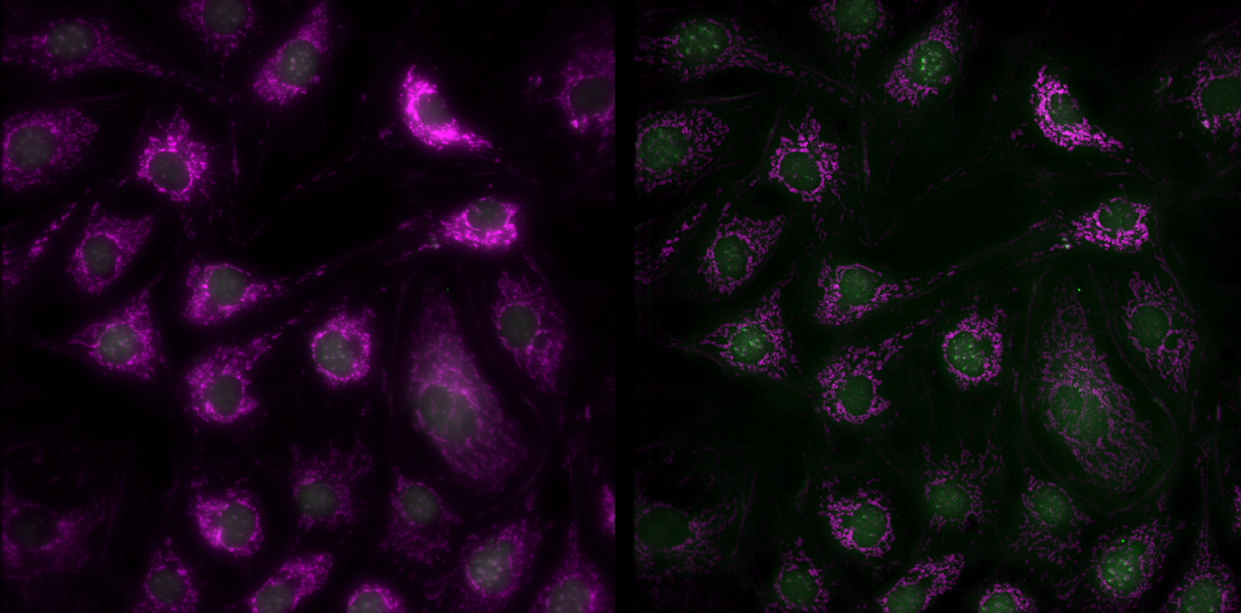
Capabilities
Built for serious microscopy
Multiple deconvolution algorithms
Twenty-three restoration methods across iterative, direct, sparsity-based, and learned-prior families — choose the approach that fits your data, acquisition conditions, and noise regime.
All major fluorescence modalities
Widefield, confocal (point, line, and spinning disk), lightsheet, TIRF, 2-photon, speckle imaging, and more. Arnas Scope handles the PSF characteristics of each modality correctly.
3D volume processing
Full 3D z-stack deconvolution with proper axial PSF modeling. Recover resolution in all three dimensions, not just laterally.
Quantitative accuracy
Intensity values are preserved and corrected — not just sharpened visually. Results you can trust for downstream quantitative analysis.
Why ArnasScope
Five things nobody else in deconvolution offers
The same recipe gives the same answer on any NVIDIA card.
A figure produced on your lab's RTX 2060 and re-derived by a reviewer on an RTX 4090 has to be the same figure. We verified it: identical recipe, two GPU architectures four years apart, agreement to 3D SSIM 0.99999769 and NRMSE 0.006%. The only differences are isolated floating-point-rounding voxels. Nobody else in this field publishes this claim.
The mathematical rigor is machine-checked.
The algorithms are driven by exact, physically grounded mathematics rather than ad-hoc heuristics. The edge-preserving regularizer's gradient identity, the accelerated proximal step-size and Lipschitz bound, and the photon-counting reparametrization invariance are proven in Lean 4 against mathlib, with zero unproven steps. Not unit-tested — proven, in the sense a mathematician means it.
It reads your camera instead of asking you to guess.
Most deconvolution software asks you for a signal-to-noise estimate. Most people guess, and the guess quietly determines the result. Arnas Scope fits the photon-transfer relation directly from your image and recovers the camera's actual gain and read noise. On our reference data it returned gain 1.201 / read 8.401 against a ground truth of ~1.2 / ~9 — without being told either.
Built to stream big data (e.g., light-sheet datasets larger than a computer's memory) without slowing down for disk access.
Modern lightsheet microscopes generate individual datasets that can reach tens or hundreds of gigabytes, crippling standard analysis tools. Instead of locking up when faced with a TIFF larger than memory, the pipeline natively chunks and writes volumetric data to Zarr — a cloud-optimized N-dimensional array format — permitting plane-by-plane streaming without ever exceeding host RAM.
It installs.
One signed installer for Windows and Linux. CUDA 12.x bundled, Python runtime embedded, DigiCert EV code-signing. You need an NVIDIA driver (≥ 566.36) and nothing else — no CUDA Toolkit, no Anaconda, no environment, no admin-rights argument with IT. Verified end-to-end on a clean machine with only a driver installed. Includes offline activation with hardware fingerprinting, for air-gapped facilities.
Methodology
Physics, not a neural network
Learned restoration models are getting very good at producing images that look right. The open problem — now well documented in the literature — is hallucination: a network can synthesize structure because its training data contained something similar, and you cannot tell by looking at the output.
ArnasScope solves the inverse problem your optics actually posed. It can over-sharpen, it can ring, it can fail to converge — and every one of those failures is visible, diagnosable, and yours to control. It cannot make something up. If your result is going into a figure, a measurement, or a regulatory submission, that distinction is the entire argument.
PSF modeling
It knows what microscope you used
The point-spread function is constrained by your instrument, not fitted in a vacuum:
- A layered refractive-index model, for depth-dependent spherical aberration
- A scalar widefield model
- Point-scanning confocal and spinning-disk models
- A hard incoherent bandwidth limit at 2·NA/λ, so the solver cannot wander outside physics
When your optics are uncertain, Arnas Scope estimates the aberration from your own data — on a real bead it found the refractive-index-mismatch spherical series directly, without being told the mismatch existed.
Algorithm library
Method breadth, with receipts
Twenty-three methods, eleven running natively in signed CUDA: accelerated iterative restoration with five convergence modes, seven regularizers spanning edge-preserving, smoothness, and robust-statistical families, three background models, a sparsity-based solver, direct single-pass filters, a variance-stabilized path for photon-limited data, and a learned-prior denoiser.
Every method carries its primary literature citation with a DOI. Your methods section writes itself, and your reviewer can check our work.
Output
FAIR-ready output
Every run writes the complete processing record beside the result — every parameter, in machine-readable form — and volumes are written as OME-TIFF carrying standard OME metadata, or as Zarr for large data. What you deposit already carries the provenance a data-management plan asks for.

The team
Nathan J O'Connor, PhD, MS
Founder, Arnas Technologies
Nathan is a co-founder of AutoQuant Imaging and one of the original creators of AutoDeblur — the deconvolution software that became the industry standard for fluorescence microscopy over two decades.
He has over three decades of experience in fluorescence microscopy, image processing, and neuroscience research, and has managed multiple SBIR NIH and DARPA grants. Arnas Scope is built on that foundation, with the benefit of two decades of additional algorithmic research.
Quote
Request a quote
Use this form to request a quote. Arnas Scope is $1,000 per seat and includes a GUI and command-line tool.
FAQ
Frequently asked questions
See what's new — release notes for every version of Arnas Scope are published at arnastech.com/release-notes.
Release notesReady to see what your microscope was always trying to show you?
Join researchers already using Arnas Scope for publication-quality deconvolution.
Buy now